Monday, October 28, 2013

My top 101 memories of Sachin Ramesh Tendulkar - #9


March 2004, Rawalpindi – 2nd ODI, India v/s Pakistan

Sachin 141 (135b, 17*4s, 1*6s)


When someone has a career as long as Sachin Tendulkar had, the ability of the person is often subjected to scrutiny at different points in time. Some critics and observers have at times made some points like Sachin is not a match winner and India loses when Sachin scores a century. In my opinion, it’s a myth; a myth which has haunted and muddled the minds of many cricket lovers. Sachin has scored 100 international centuries; 53 of them helped India win the match and 22 of them came in draws, ties & abandoned matches. That leaves us with 25 centuries scored by the ‘Little man’ which could not take the team through the finish line. I know the statistics never convey the complete story but just take into consideration the fact that India has not been among the strongest teams of the world for most of the playing career of Sachin. It was only after the turn of the new millennium that players like Rahul Dravid, Sourabh Ganguly and VVS Laxman became potent enough to shoulder some of the burden that this great man carried single handedly for so long. Let’s talk about one such innings in which Sachin kept on looking for the support which never came; one such century which could not win the match for India; one such instance when he disappointed those who expected him to be a match winner.

In 2004, India visited Pakistan for a full tour nearly after 15 years. The last time Indians were in Pakistan, a young teenager made his debut for India. The stories of a broken nose and shattered window of Peshawar Cricket Ground are a part of the cricketing folklore; in both the cases the youngster was the protagonist. The child prodigy had grown up and had become the most feared batsman in the world; Sachin Ramesh Tendulkar. Sachin was the only player in the Indian team to have played both forms of the game in Pakistan so it was his responsibility to guide the team forward in this high voltage series. In the 1st ODI, India piped Pakistan by 5 runs in a nail-bitter. Pakistan struck back with vengeance in the 2nd game at Rawalpindi and after selecting to bat first, they piled up a mammoth total of 329. Pakistan and steep challenge, it was all that was needed to charge up Sachin; he brought his ‘A-game’ to the fore. Sehwag and Sachin opened the innings for India. Sachin played out the first 3 overs with caution; he even played out a maiden off arch rival Shoaib Akhtar. In the fourth over, Shoaib with his ego pumping after the maiden, charged into Sachin. Bang!! A lifted square-cut off a 145kmph delivery, raced into the fence. The bowler spat in disgust and went back to his mark. The next one was faster; 150kmph, on the middle-stump. Sachin played a magical flick for another boundary; He had decided to fight fire with fire. The Pakistani speedsters kept on bowling fast and Sachin’s bat kept on dispatching them faster. Many times the pacers drifted it into the pads of Sachin and he played some glorious shots through the on-side. His placement was so precise that evening that he even bisected the minuscule gap between the wicketkeeper and the short fine-leg of Shabbir Ahmed for a four.

The wickets kept on tumbling from the other end but nothing affected Sachin’s focus. Sachin completed his fifty with a single of Shoaib Malik; it took him 61 balls to reach the land mark and in the process he smashed 6 classy boundaries. In the very next over, he completed his 13,000 ODI runs with a single. By this time the required run rate had climbed up to 7.25 runs per over. Sachin started looking for boundaries in every other over and more often than not was successful. He played a powerful on-drive off Sami, a deft glance off Afridi and a skillful paddle-sweep off Shoaib Malik; all for smashing boundaries. In fact between 20th and 30th over, he was able to get a boundary in 8 of the 11 overs. The planning, calculation and execution of the knock was of top notch.

At the end of 30 overs, India was left with a daunting target of 153 off 120 balls with 7 wickets to spare. Sachin completed his century with a single of Shoaib Akhtar and became the first Indian to score an ODI ton on the Pakistani soil. But Sachin didn’t celebrate much; he knew that the mountain in front of him was too steep and scaling it would require all the energy that he could muster. He decided to cut loose and slog-swept Afridi for a huge six over mid-wicket. A couple of boundaries off Shoaib Malik and Abdul Razzaq each kept India on track. But with Rahul Dravid on other end failing to keep up the momentum, Sachin went for a shot too many. Another slog-sweep towards the mid-wicket was caught by Abdul Razzaq. Sachin accumulated 141 runs off 135 balls with 17 fours and a solitary six. The glass castle of Indian batting line-up came down crashing after that. All the remaining batsmen fell in the pursuit of quick runs. Some lusty hitting by Laxmipathy Balaji and Romesh Pawar was not sufficient and we lost the game by 12 runs.

A heartbroken Sachin collected the Man of the Match trophy afterwards. He would have loved to swap it for a victory any given day. But that is not how it works. The second highest contribution on the score sheet was 37; approximately a quarter of what Sachin scored. This valiant effort came in from Pakistani bowlers in form of extras.


Friday, October 25, 2013

My top 101 memories of Sachin Ramesh Tendulkar - #8


March 2009, Christchurch – 3rd ODI, India v/s New Zealand

Sachin 163* (133b, 16*4s, 5*6s)


At times Sachin Tendulkar has been blamed for not playing really big innings in Tests. The all-time batting greats like Donald Bradman and Brian Lara were known for their capabilities to hang in there for long durations and score big double centuries & triple centuries. But Sachin, who has been considered as the most complete batsman of the era has failed on that front. However the story changes in the shorter format of the game. No one ever got a chance to place this blame on him in ODIs; the format in which he breached the 150 mark five times, a world record. The fact that Sachin was an opener and had mastered the art of constructing an innings, helped him to pile up big runs in ODIs. He never had to sacrifice the class and elegance to accelerate the scoring rate; a career strike rate of 86 in ODIs is a testimony to that. But at times he donned the mask of this mischievous kid and took to making some ugly heaves to score those runs.

India squared up against New Zealand at Christchurch in 2009 for the 3rd ODI of the series. The AMI stadium of Christchurch has always been the heaven for the batsmen because of its small boundaries. New Zealand won the toss and decided to field as they fancied chasing anything that India could have thrown at them on this small ground. But Sachin had dismantled better plans in trickier condition and against stronger opponents. Kyle Mills bowled a no-ball to Sachin in the very first over. As per the new rules the following ball was to be a free-hit. Sachin didn’t need an invitation to pounce on the opportunity; an over-pitched ball on the off-stump was threaded between point and third-man for the first boundary of the game. Sachin was on his way; he played some glorious shots of Tim Southee and Mills. In the 9th over, Mills bowled a slower one on the off-stump. Sachin went down on the knee and slog swept it through mid-wicket for four. It was a good hit but something was different. The stroke lacked elegance; the elegance and class that Sachin’s game personified. At that point in time, I didn’t knew that this would be the theme of the day. After that shot, Sachin kept playing a composed game with singles and doubles. In between, a cover-drive of off Ian Buttler went to the fence with some familiar charisma and a leg glance into the fine-leg fence off the same bowler took Sachin through his fifty. Sachin completed his half -century off 59 balls.

Nothing suggested that this was anything extraordinary for the great man. No one had any idea about the carnage that followed. A Yorker length ball by Jessy Ryder was cheekily played between the short third-man and point for a four; a full delivery by Southee on leg-stump was paddled over the fine-leg for a six; both the shots looked artistic and ugly at the same time. Ryder was punished some more when Sachin’s unorthodox shots on the on-side breached the boundaries off consecutive balls. The part-time seam-ups of Grant Elliott were not spared either and Sachin hammered one over long-on for a six; it went higher than long and just cleared the fence. This took Sachin into 90s. After some cautious singles, Sachin completed his century with a single off Elliott. This was his first ODI hundred on the kiwi land. In a customary fashion, he thanked god and went back to bat. After that all hell broke loose. In the very next over, Jeetan Patel was left in tatters as Sachin hammered a huge six over his head and followed it with a four through point. By then I had stopped looking for class and was enjoying the hitting that was unfolding in-front of me.

Mills’ bad day at office continued when the ball slipped out of his hand and ended up being a full toss on the leg-stump. Sachin piled on his misery when he paddled it for a four through the ropes of fine-leg. In the very next over, Sachin scooped one to the short third-man but the fielder made a hash of it. The relentless kid added insult to injury when he smashed Southee in the same over for another boundary. Often dropping Sachin in such mood is dubbed as a sin and culprit Elliott found out soon enough. Sachin craved a six and a four off him in back to back deliveries in 44th over; both the shots through extra-covers. With the six Sachin crossed the 150 mark and looked set to scale the ‘then virgin peak’ of 200 in ODI.

Playing ugly hoicks than relying on his repository of soothing shots took its toll. After smashing Elliot for the four, he tried to execute a pull and in the process strained his abdominal muscles. Wincing in pain, he decided to continue. But things got worse when he had to duck out off a beamer for Ryder. The grimace on the face of Sachin suggested the pain was excruciating. He tried again and with all his perseverance he faced the next ball. The apologetic Ryder went a step ahead and bowled a half volley. Sachin obliged with another six over covers; Apology accepted, I thought in my mind. But that was it. The effort it took to send the ball into the crowd drained all the reserves of Sachin and he walked off the ground. He scored 163 of just 133 balls with 16 shots to the fence for four and 5 hits into the crowd for six. A chance to take the ‘virgin peak’ went into the mud.

That day Sachin demonstrated that he could take on Tilakratne Dilshan and AB De Villiers in the game of ugly swipes any given day. Sachin was declared the Man of the Match.


Wednesday, October 23, 2013

My top 101 memories of Sachin Ramesh Tendulkar - #7


December 2005, Delhi – 2nd Test match, India v/s Sri Lanka

Sachin 109 (196b, 14*4s, 1*6s)

In his long and illustrious career, Sachin has not shown many short comings; that is, if he has shown any at all. But if I had to take my pick, then I would say it was the indifference in his game when he approached any big milestone. For example, in 2009 when India squared up against Australia for a 7 match ODI series, Sachin was on the verge of completing his 17000 runs in the 50 overs format of the game before the series. But Sachin’s game was tentative; he looked stressed and failed to get going in the first 4 games of the series. What transpired in the 5th match is an epic but the bottom-line was the pressure of the expectations got to him for a change. However, he always found out ways to break out of the nutshell and be the flamboyant stroke-maker that we know him as. And something similar happened when he was stuck on for quite some time on 34 Test centuries.

India versus Sri Lanka test matches in late 1990s and early 2000s were often dubbed as ‘the battle of the maestros’. Sachin lead the batting line-up for India and Muralitharan showed the way for the Sri Lankan bowling attack. It was an era of exciting contest between the bat and the ball. Indians were renowned for their crafty batting against the spinners and the Sri Lankans were the finest exponent of spin bowling. So when the Sri Lankans came to India towards the fag-end of 2005, the excitement was palpable. The series was eagerly awaited for another reason. Sachin had spent almost 17 months without a test century. He was stuck at 34 of them; the World record which he was sharing with Sunil Gavaskar at that point in time. The century that would break the long standing milestone had taken a long time to come. The anticipation of the inevitable was transforming into frustration for the cricket lovers. But then the prayers of a billion fans were finally answered in Delhi, when the two teams squared up for the 2nd test.

On slow and dry wicket, Indian skipper Rahul Dravid won the toss and elected to bat first. India made a horrendous start to the proceedings when Gautam Gambhir departed in the very first over. But Dravid and Laxman lent some stability to the innings with a partnership of 54 runs. Dravid’s dismissal to a classical off-break from Muralitharan brought Sachin to the wicket. Sachin started with caution. He took his time to settle down and didn’t play any aggressive shots. Sachin waited for the loose ball but they were at a premium that afternoon. Dilhara Fernando bowled a couple of them; they were full and drifting in to the pads; Sachin flicked them into the fence and went back to the cautious mode without any fuss. Most of his runs came in singles and doubles but once in a while he also dispatched a few to the fence. Muralitharan was bowling a tantalizing line to him to deceive him in flight, but Sachin refrained from taking the bait. But when he was in his 40s, he played a glorious cover drive of the off-spinner for a rare boundary. The concentration and temperament of Sachin was at its full throttle. With time, his fluency came back into his game and the runs started to flow freely.

Sachin started the post Tea session with a bang. Muralitharan was thwarted by the patience of the ‘Little champion’ and decided to try something different. He came round the wicket to change the line of attack. First ball was a flighted delivery; Sachin jumped up to the pitch of the ball and played an inside-out cover drive; the ball rocketed into the fence for a four. Second ball was short and spun the other way; Sachin rocked on to the back-foot and executed a ferocious square cut through Third-man for another boundary. The next ball was fractionally short; but the little man punched it through the off-side with great panache for another boundary. The ‘Spin Doctor’ was served with 3 fours off 3 balls. The shackles of constraint were broken. Sachin also blasted a six of Malinga Bhandara; it was a tremendous shot of a good ball. On the sight of a flighted leg-break, Sachin danced down the pitch and hammered the ball out of the long-on fence for huge six. The onslaught forced the Sri Lankan captain to bring back Chaminda Vaas into the attack. But he could not do much either to stem the flow of runs. Sachin craved 2 boundaries in one over of Vaas on either side of the wicket; the second boundary of the over brought Sachin into the ‘nervous nineties’.

The syndrome of ‘nervous nineties’ had been Sachin’s ‘Achilles heel’ in the latter half of his career. Sachin holds the record of getting stuck in 90s; 28 is the number of instances with Tests and ODIs combined. It is just another entry into a long list of records which would stand the test of the time. Hence, whenever Sachin got into that zone of 90 to 100, the whole of India went into a trance of fear and anticipation.

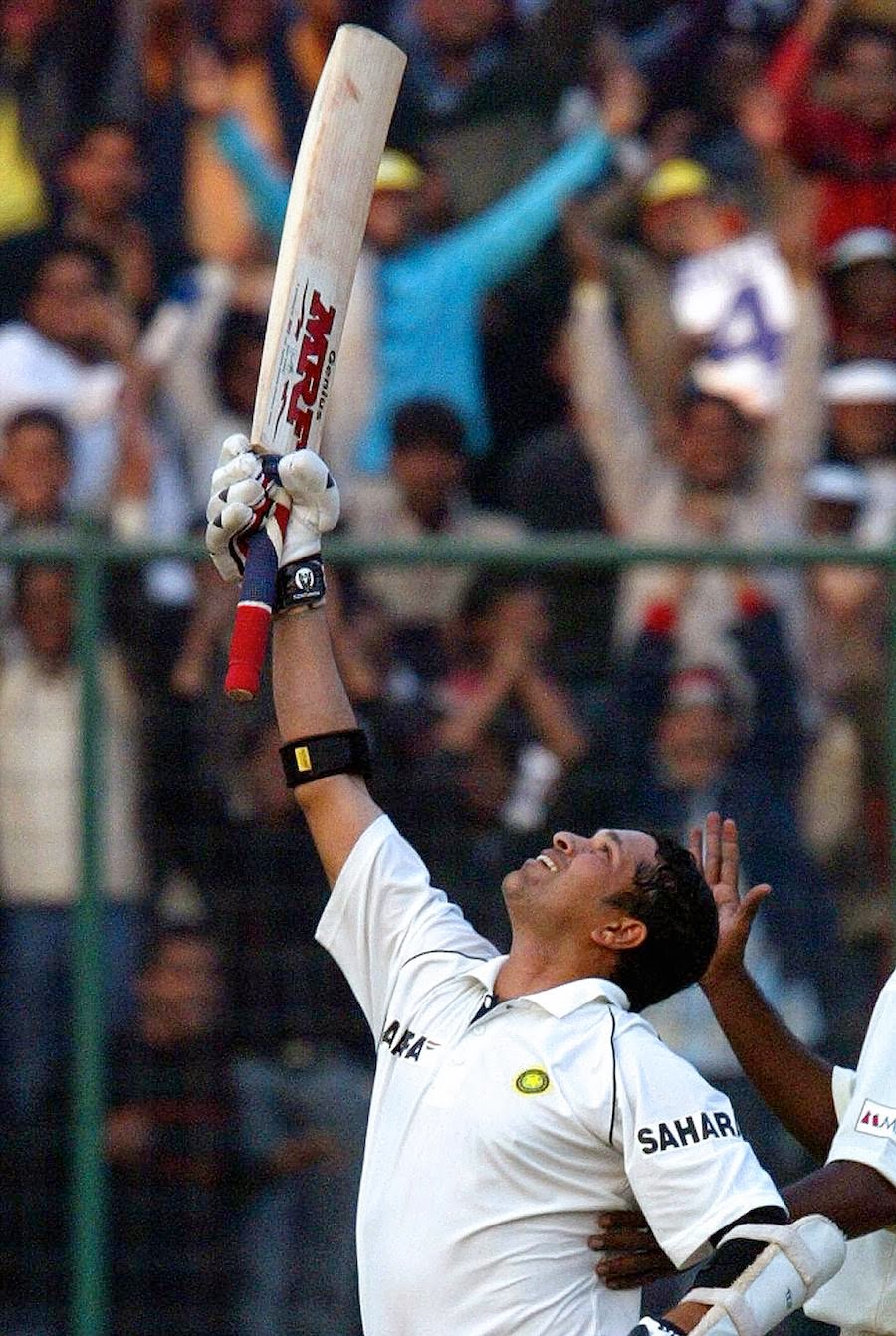
But that day Sachin was in a different zone. He played with all the composure he could muster. He paddled a delivery from Vaas through fine-leg for a boundary with ease to move to 97. The milestone was at a touching distance now; but he had to wait for another nine balls to make those 3 runs. When he was on 99, Sachin nudged one on the leg-side off Vaas and took off for a single. Even before he completed the run, he punched the air and the crowd erupted. The long standing record of Sunil Gavaskar had fallen; the pupil had beaten the teacher. The 35th century took its time to come but the nation gave it the celebration that it deserved. It was not the most exciting knock that Sachin played in his career, but in terms of discipline and temperament, it was a gem.

India won the match and Sachin ended up being the only centurion of the match.


Tuesday, October 22, 2013

My top 101 memories of Sachin Ramesh Tendulkar - #6


December 2001, Ahmedabad – 2nd Test match, India v/s England

Sachin 104 (197b, 12*4s, 1*6s)

In the winters of 2001, the English came to India to play a 3 match Test series under the leadership of Nasser Hussain. England had been terrible tourists to India for quite some time now. The main reason behind their abysmal record was their impotency against quality spin bowling. In the semi-finals of 1987 World Cup, Graham Gooch swept India out of the tournament. After that the over reliance on the sweep shot often led to the downfall of the English batsmen against Indian spinner. On the other hand, Indians were this invincible power at home. So this series was expected to be a one sided affair. In the first test at Mohali, India displayed their supremacy with a dominating performance and thrashed the English by 10 wickets. The English looked as clueless as they were expected to be and the test lasted less than 4 days.

After the humiliation in the first test, Nasser Hussain took some drastic decisions. He bought in Ashley Giles into the playing eleven. This decision drew a lot of criticism because the left arm spinner was short on match practice. On a dry pitch of Ahmedabad, under the scorching sun, England won the toss and opted to bat first. This time the English batsmen put on an impressive show and piled up 407 runs. Sachin bowled a few leg-breaks and accounted for Mark Ramprakash. By the time India came into bat on the second day, the pitch was scuffed up and the cracks on it were starting to open up. India made a decent start but the openers fell in quick succession to bring Sachin on to the crease. Sachin and Dravid played for the close of the day's play and India ended the 2nd day at 71 for 2. On the third morning of the Test match, Sachin started positively. He swept Richard Dawson for a boundary through the fine-leg region. But soon Indians were served with an unpleasant surprise. The ball was reversing sharply due to the rough surface. Hussain put Mathew Hoggard, Andrew Flintoff and Craig White to do the honors and they obliged with some classic reverse swing. From the other end, Hussain deployed Ashley Giles to go over the wicket and bowl his left arm leg-breaks. The spinner maintained a negative line tactics by regularly pitching the ball outside the leg-stump. This dried the flow of runs and Dravid & Sourav Ganguly played rash strokes to lose their wickets. India was reduces to 93 for 4 and Sachin decided to take the attack to the opponents.

Sachin switched to a middle stump guard and started to shuffle outside the off-stump to negate the swing. The plan was to flick, glance or on-drive anything that was full. Soon after the fall of the 4th wicket, White came in to ball to Sachin. After a few good length balls, he pitched one up to the bat in search of the coveted reverse swing. After pitching on off-stump, the ball swung outwards. Sachin covered the line with some nimble footwork and flicked it through mid-wicket for four. The counter attack commenced. Couple of overs later, Hoggard tried the same thing, this time the ball crashed into square leg fence for four more. Sachin completed his half-century with the stroke. Hussain sensed the change in tempo and bought back Giles to choke the run flow. To begin with, Sachin replied with some crafty paddle sweeps to fine-leg for singles and doubles. Once he got used to that line, Giles was smashed harder and this time it crossed the ropes, leaving the fine-leg fielder to fetch the ball back. In the very next over, Hoggard pitched one outside off and Sachin drove him through cover for sublime four. Couple of balls later, another full delivery on the stumps by Hoggard evoked similar response. It was driven but this time through mid-on for a sparkling four. The class of Sachin was on exhibition that afternoon. England had packed the off-side field but the ‘Little Master’ ridiculed the opposition by whipping balls from outside off through the leg side at will. With Hoggard being treated with disdain, Dawson was brought back to the attack. But he was not spared either. A tossed up ball by him was nailed over the long-on fence for a big six.

Sachin capped of this disciplined and classy effort with a century; he reached to the three figure mark with a sweetly timed leg glance off Hoggard to square leg for four. This was Sachin’s 27th Test century and it left him at number 3 in the list of highest century makers behind Sir Donald Bradman and Sunil Gavaskar. In the very next over India crossed 207 and avoided the follow-on; a task which looked improbable when India lost 4 wickets within 100 runs. This faultless knock came to an end when Sachin miss-timed an on-drive to Nasser Hussain at mid-on.

This innings helped India to draw the match and maintain a lead of 1-0 in the series. This was one of the many epics that Sachin penned down single handedly to rescue the team from a crisis.


Saturday, October 19, 2013

My top 101 memories of Sachin Ramesh Tendulkar - #5


January 1998, Dhaka – Silver Jubilee Independence Cup, India v/s Pakistan (1st final)

Sachin 7-0-45-3  &  95 (78b, 6*4s, 5*6s)


The year 1997 was a disappointing one for Indian cricket. We fared badly in Tests and in ODIs we ended up just above Kenya and Zimbabwe in the ICC ranking list. Sachin was the captain of the team and the pressure of captaincy was affecting his individual performance adversely. Azharuddin was even quoted in some newspapers saying “Nahin jeetega! Chote ki naseeb main jeet nahin hai”. So with the mutual consent of the selectors and Sachin, the little champion stepped down as the captain of Indian cricket team. Azhar took over the responsibility of captaincy and the Indian team was ready to make a fresh start.


In 1998, the first assignment for Indian cricket team was the Silver Jubilee Independence Cup. The BCB had organized this triangular tournament between Bangladesh, India & Pakistan in Dhaka to celebrate the 25 years of Independence of Bangladesh. The tournament was a real short one as it had just 3 league matches & 'best-of-3-finals'. All the six matches were spanned across 9 days. As expected before the tournament, India and Pakistan qualified for the finals. Sachin played freely and scored half centuries in both the league matches. The burden of captaincy was not allowing him to play his natural game; but with that responsibility gone, he was re-discovering his touch.


In the 1st final, Pakistan won the toss and decided to bat. It was a dry looking wicket and it was expected to slow down as the game progressed. All the top order batsmen got the starts but none of them went on to make a big one. After the fall of the 3rd wicket, Izaj Ahmed and Inzamam-Ul-Haq came together and started to build a steady partnership. Azhar was well aware of the hitting prowess that the two set batsman possessed. Hence, he tried everything to break the partnership. In the 36th over, Azhar turned to Sachin. Sachin carried this reputation of being a partnership breaker and more often than not, he lived up to the hype. Izaj Ahmed underestimated a flighted delivery from Sachin. He stepped out of the crease to heave it out of the ground but made no connection with the ball. Nayan Mongia disturbed the furniture in a flash to get India the vital break through. From there on there was no stopping. In the very next over Sachin accounted for Inzamam, when he played a silly shot directly into the waiting hands of Harvinder Singh. Sachin completed a 3 wicket haul when he scalped Manzoor Akhtar. With this disciplined bowling effort, India was able to restrict the opposition for 212 runs. Sachin played a handy role and was the highest wicket taker for the team. But he was not done yet.


Sourav Ganguly and Sachin walked out to open the innings for India. In the second over, Sachin went on to the back foot to square cut a short ball. The pace and bounce of the pitch beat Sachin and the ball took an inside edge to the fine-leg fielder. He realized that the pitch was sluggish in nature and would slow down further as the game goes on. So Sachin decided to go after the bowlers and chase down the target before the bounce of the wicket dies down completely. He played a few aggressive shorts of the pacers but the most notable one came off the bowling of Azhar Mehmood. The bowler pitched it short to push Sachin on the back-foot but the lack of pace and bounce made it a dolly. Sachin adjusted his stance and pulled it through the empty mid-wicket region for a four. The experienced Aqib Javed failed to stop the carnage too. Sachin stepped out to him and slapped a six over the mid-wicket fence with ridiculous ease. A worried Pakistani captain, Rashid Latif bought his premium spinner, Saqlain Mushtaq to get some respite. But Sachin made a mess of his bowling figures. In the 11th over, he lofted Saqlain straight over his head for a huge six. The very next ball was launched into the stands through the long-on region for the same result. He was fierce and fearless in his approach. He completed his half-century off just 43 balls with three boundaries and 3 sixes. He also complete 6000 runs in ODIs when he reached the score of 45. Till date Sachin remains the youngest player to reach that milestone.

With Saqlain failing to keep a check on the run-flow, Mushtaq Ahmed was given the ball. The move backfired. Sachin hammered two huge sixes of the leg-spinner over the mid-wicket region. This persistent battering demoralized the bowling team and everyone in a green kit looked helpless against this onslaught. The skipper tried different bowlers but nothing worked. The scorecard sailed beyond 150 without any casualty and the runs came with a run-rate greater than 6. Sachin scored 95 off 78 balls before he was bowled off a delivery by Shahid Afridi. There was not much of celebration by the Pakistani team because they knew that the little man had taken the game out of their hands. India went on to win the match by 8 wickets and with nearly 13 overs to spare.

Sachin was declared Man of the Match for his superb all-round performance. With this knock, he completed three back to back half centuries in the tournament.


Friday, October 18, 2013

My top 101 memories of Sachin Ramesh Tendulkar - #4


May 1999, Bristol – ICC World Cup, Group A, India v/s Kenya

Sachin 140 (101b, 16*4s, 3*6s)


Sachin Tendulkar has been a part of last 6 ICC World Cups. In 1996 and 2003 he ended up as the highest scorer of the tournament and in 2011 he ended up second on the scoring charts with Tilakratne Dilshan just piping him to the helm. The impact was evident on the performance of India. In 1996, we ended up in the semi-finals. In 2003, we were the runner-up and the World Cup was painted blue in 2011. On the contrary in the 1992, 1999 & 2007 editions of the World Cup, Sachin failed to live up to the benchmark he sets for himself and India fared miserably in them. India’s fate in the quadrennial showcase event has been closely tied to the performance of the premier batsman of the team. The little man carried the expectations of the whole nation on his shoulders and he did it with a smile.

In 1999, when the Indian team took the field against Zimbabwe, I was stunned to see the team without Sachin. After some frantic enquiries, I found out the reason behind his absence. Mr. Ramesh Tendulkar, father of Sachin had passed away and Sachin was on his way back to attend his funeral. India lost the match and in the end of it I was sad because of more than one reason. We lost to a lowly team like Zimbabwe and that too in the flagship event of cricket. We lost two games in a row and qualification to Super-Sixes was in doubt. And there was an air of uncertainty around Sachin’s further participation in the tournament. Yes, we fans have been that selfish all our life. We just wanted Sachin to play for us all the time without any break. Injuries, personal tragedies, family commitments; we never understood that even Sachin can have such trivial things to deal with in his life. But the legend has never complained and neither have his family. Sachin’s mother persuaded him to rejoin the squad by saying “Your father would have wanted you to play”. And Sachin took the flight to London the next morning.

India was playing Kenya at Bristol in the next round robin match. Sachin landed from the flight and directly walked into the team sheets. Jet lagged and emotionally drenched; but he knew that his team needed him; the nation wanted him and the man obliged in some style. On a flat pitch, India opted to bat after winning the toss. The opponents didn’t have a bowling attack to trouble the star studded batting line-up but the conditions were damp. Sourabh Ganguly walked out to open with Sadagopan Ramesh and made a cautious start. We reached 50 without any casualty but the run rate was quite slow. Dada was the first one to fall and then Rahul Dravid walked out to join Ramesh in the center. They kept on negating the Kenyan attack with ease but the scoring rate took a beating. In the 21st over, a mix up between the two batsmen let to the dismissal of Ramesh. With the fall of the 2nd wicket, Sachin came out to bat at number 4 amidst huge cheers. As India had lost two of the matches, so keeping a health net run-rate was important. Sachin knew what was needed. He didn’t take long to get off the blocks and executed a perfect on-drive of Thomas Odoyo for four runs. A little later a sublime square-cut followed off the same bowler. He looked in great nick as he negotiated the Kenyan pacers with ease. Asif Karim, the Kenyan skipper relived the pacers off the duty and went for an all spin attack. Sachin was equal to the task again. He swept Maurice Odumbe for a boundary and deposited Karim over the long-on fence for a huge six. Sachin raced to his 50 of just 54 balls in the 35th over and in the process he managed four boundaries and a six.

The scorecard read 178/2 in 35 overs with the run-rate now touching the five run per over mark. Sachin decided that it was the time to cut loose and carnage followed. The slow bowler of Kenya hardly provided the batsmen with any pace to work around with, so Sachin fell back on back-foot and started hitting the balls toward the on-side. He pulled Steve Tikolo to the midwicket fence for a four and then lofted Odoyo out of the ground for a six through the same region. Tikolo was chosen for some more punishment when Sachin slammed four boundaries off his bowling in nine balls. Sachin completed his century of 84 balls; he zoomed away from 50 to 100 in just 30 balls. His second fifty comprised of seven fours and a six which accounted for 34 of the runs scored. This was the first century scored in the 1999 edition of the World Cup. On completing the century, the little master opened his helmet, looked towards the heaven, dedicated the knock to his late father, wiped his tears and got back to the game. With just 6 more overs to go, Sachin went for the leather hunt. Odumbe was treated with similar disdain when he was slammed for three back to back boundaries. The first one was full toss which got driven through the covers, the second one was swept through the fine-leg region and the third one was artistically turned to the third-man fence. To cap it off, Sachin pulled the last ball of the innings from Joseph Angara for a six over the deep mid-wicket.  In the last 17 balls that Sachin faced, he hammered a six and five shots along the ground to the fence to accumulate 40 runs. He ended up with an unbeaten 140 off just 101 balls.

Sachin and Dravid shared a then world record partnership of 237 runs for the 3rd wicket. Sachin was adjudged the Man of the Match for a scintillating century.

Wednesday, October 16, 2013

My top 101 memories of Sachin Ramesh Tendulkar - #3


April 1998, Kochi –  1st ODI of Pepsi Triangular Series


Sachin 10-1-32-5


Most people recognize Sachin Tendulkar as this world beating batsman. But there is more to this dynamic sportsman. He is a very safe fielder and a perfect ‘All in One’ bowler. He bowled leg breaks, off spins and seam ups with equal ease. There is a very interesting story about Sachin when he was very young. Sachin went to a camp in Chennai organized by MRF Pace Academy. He met the legendary Denis Lille in the camp. He told Lille that he wanted to be a fast bowler and Lille explained to him that he lacked the physical stature to become a fast bowler. He advised Sachin to concentrate on his batting and Sachin obliged. But the boy who wanted to do crazy things with the ball was always there in his heart. And that fine afternoon at Kochi, he let that boy out.

After pounding the Kangaroos in the Test series with the bat, Sachin was expected to carry on his form into the ODI series too. India squared up against the Australians at Kochi in the first match of Pepsi Triangular Series. But this was one of those rare occasions when he failed. But Ajay Jadeja and Hrisikesh Kanitikar filled in for him and on a flat pitch India asked the Aussies to chase 310 in 49 overs.

Australia replied with intent and looked on course with 110 runs to go in last 18 overs. Michale Bevan and Steve Waugh were accumulating the runs at a steady pace. Bevan carried this reputation of being the best finisher of the games in limited overs format and Indian skipper Azhar had all the reasons to be worried about. He tossed the ball to Sachin to bowl the 32nd over. Sachin always had this knack of breaking crucial partnerships with some part-time bowling. Sachin decided to test Bevan with some off-breaks. The idea was to take the ball away from the left hander and not to allow him to plunder easy runs on the on-side. Bevan changed ends with a single off the second ball. That bought Steve Waugh to strike. Sachin flighted one to him and Waugh stepped out at the glimpse of it. Waugh being a right hander was expecting the ball to break into him and hence he was ready to flick the ball through the mid-wicket region. But his worst fears came to haunt him when the ball pitched just in front of his bat and started to turn away from him. He edged it back to Sachin and Sachin accepted it with glee. In celebration he started to juggle with the ball as if mocking the batsman that he got him. Waugh left but the danger man Bevan was still there.

Encouraged by the turn that Sachin was getting, Azhar persisted with him. And it paid of in the 36th over. A sliding off spinner from Sachin caught Darren Lehman low on the pads, plumb in front of the stumps. Two quick wickets made it a “even money bet”. But every Indian was aware of the threat that Bevan possessed and hence the tension was palpable among the Indian supporters. But then Sachin was on fire. In the last ball of the 40th over, he tricked Bevan to step out to a tantalizing faster one which was sliding into him. Bevan was shaping up to loft this one on the off-side. But this one kept on coming in to Bevan and he was cramped for room. He missed the ball and Nayan Mongia wiped the bails in a flash. The last hope of the Australians was foxed and one could almost hear out the phrase ‘April fool’ from the demeanor of Sachin at that moment. It was more about delaying the inevitable from there on.

But Sachin was in no mood of relenting. In the first ball of the 42nd over, Sachin bowled a classical leg spinner, pitched at a good length spot. Tom Moody made a pre-meditated heave and missed it all together. The waiting gloves of Mongia did the rest. Sachin was on a hat-trick now. He was turning the ball square and Shane Warne walked out to witnessing the drama on the pitch himself. I bet he would have envied what the “Little Genius” was doing with the ball. Things were a little interesting now. Shane Warne was facing Sachin to negate the hat-trick ball. Sachin sent down a loopy leg break and Warne went for a square cut. He edged it and Mongia snatched at it. The ball bounced out of the gloves of Mongia and went down. Sachin grimaced a little but ran back quickly to his bowling mark. The next four deliveries would have made Warne proud; if not for the fact that he was at the receiving end. Sachin finished the rout with the 5th wicket of Damein Martyn, who played a nothing shot to lob one down the long-on’s throat. Sachin ended up his full quota of overs with 5 for 32 and a maiden to go with it. It remained the best bowling performance by the legend in ODIs. With this effort he won the match for India and piped the centurion Ajay Jadeja to become the Man of the Match.
That day he left me with no doubt that if Dennis Lille would not have advised him otherwise, he would have become a great bowler.